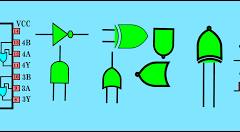
Combinational and Séquentail Logic
This course material introduces Combinatorial and Sequential Logic (CSL), a fundamental subject for
second-year LMD students in various fields like automation, electrical engineering, and computer science.
Mastering CSL equips students to comprehend and assimilate future modules in their licence or master's
program, such as Advanced Digital Architectures, Microprocessors, Microcontrollers, DSP circuits, and
FPGAs. To bridge the gap between theory and practice, we've included numerous examples of integrated
circuits. This focus on practical applications ensures that this resource is beneficial for second-year LMD
students.
The course explores both Combinatorial and Sequential Logic. In Combinatorial Logic, the output is
solely determined by the current inputs. We've covered logic gates and basic combinational circuits. In
Sequential Logic, the output depends on both current inputs and previous states. We've introduced flip-flops
and circuits like counters and registers.
This course material supports "Digital Electronics: Fundamentals Combinatorial and Sequential Logic."
It's divided into six chapters as follow:
Chapter I: Boolean algebra and simplification of logic functions
Introduces logic functions (AND, OR, XOR, etc.) and Boolean algebra.
Presents canonical forms and simplification methods (algebraic and Karnaugh maps).
Chapter II: Introduction to Number Systems and Coding
Covers binary, octal, decimal, and hexadecimal bases.
Explains conversions between bases and binary arithmetic.
Numeric and Alphanumeric Codes: DCB, GRAY, and ASCII, with their respective uses and
applications.
Chapter III: Combinational Circuits
Details arithmetic circuits, encoders, decoders, transcoders, comparators, multiplexers
and demultiplxers.
Chapter IV: Sequential Logic
Explores the concept of time and flip-flops (RS, JK, D, T, Master-Slave).
Chapter V: Binary Counters
Covers asynchronous and synchronous counters.
Chapter VI: Registers
Discusses storage and shift registers.
Each chapter concludes with practical exercises.

TP Méthodes numériques (Dr Mohammed A DJEHAF)
Semestre: 4
Unité d’enseignement: UEM 2.2
Matière 4: TP Méthodes numériques
VHS: 22h30 (TP: 1h30)
Crédits: 2
Coefficient: 1
Objectifs de l’enseignement:
Programmation des différentes méthodes numériques en vue de leurs applications dans le domaine des calculs mathématiques en utilisant un langage de programmation scientifique (Matlab, Scilab, …).
Connaissances préalables recommandées
Méthode numérique, Informatique 2 et Informatique 3.

techniques d'expression et de communication

Le module de Techniques d’expression et de communication est un module de base dans la deuxième année licence en automatique, électromécanique et électrotechnique.
Ce cours intitulé «Techniques d’expression et de communication» permet de vous initier au domaine de rédaction et de communication orale et/ou écrite, Ce cours doit aider les étudiant de la 2ème année Licence à améliorer rapidement leur expression. Avec plusieurs exemples, ce cours se veut pragmatique : aller à l'essentiel et s'appliquer immédiatement à toutes les situations.
Ce cours est scindé en un ensemble d’unités d’apprentissage qui vous permettent d’acquérir des connaissances en matière d’expression et de communication orale et/ou écrite.